
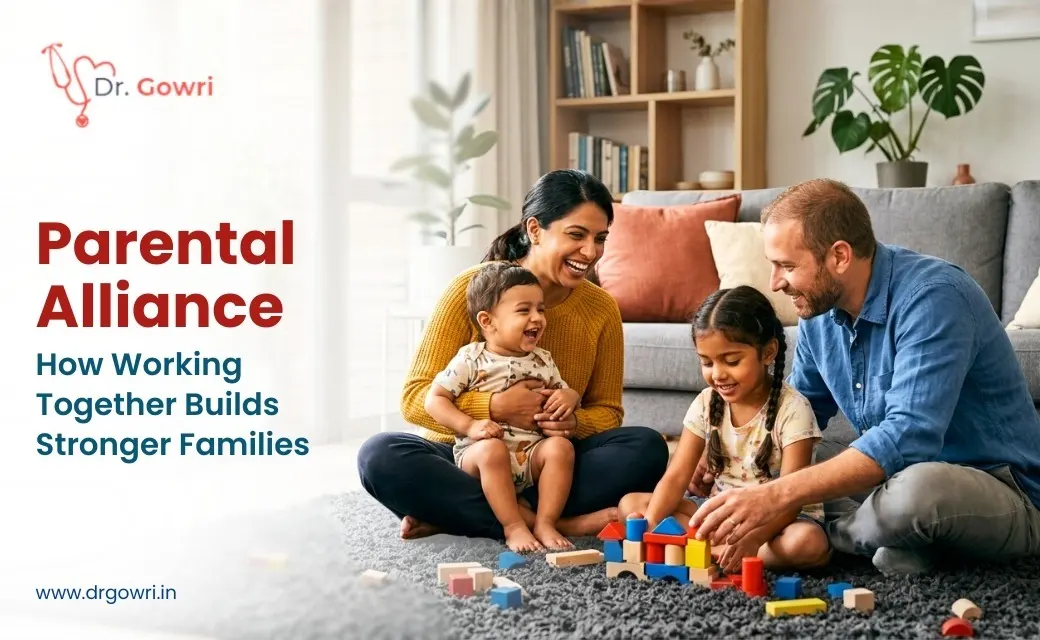
“Children are happiest when the adults in their lives work together with respect and love.”
-Dr. John Gottman
Parenting isn’t a solo act it’s a team effort. Regardless of whether parents are married, separated, divorced, or co-parenting, their working well together will have a significant influence on the child’s emotional well-being.
Parental Alliance is the term used for this partnership between parents. It is all about giving each other support, communication, and a common commitment to doing what’s best for the child.
What Is Parental Alliance?
Parental alliance is the bond among adults who share responsibility for parenting a child. It refers to the extent to which parents collaborate, respect one another’s parenting roles, and work together to resolve parenting dilemmas.
Why Parental Alliance Is Important?
- When parents stand by one another, children feel protected and secure.
- Minimizes behavioural issues in children who have a good working relationship.
- Healthy parental collaboration role-plays solving problems, showing respect, and healthy communication among children into adulthood.
- If parents feel they’re a team, they feel less burdened, less isolated, and more capable of managing parenting stress.
- For partnered or married parents, a solid partnership can even enhance the general relationship and decrease conflicts.
Indicators of a Strong Parental Partnership-
- The parents respect and trust one another’s parenting choices.
- They make rules and set boundaries in concert.
- They never criticize one another with the child present.
- They divide parenting responsibilities equally.
- They maintain a “united front” in the case of large decisions.
- They listen to one another’s concerns without judgment.
Obstacles to Parental Partnership-
Even the strongest parenting couples can face problems on their way of parenting. Some common problems can be:
- Differences in Parenting Styles, like one parent may be strict, the other lenient.
- Busy schedules, financial pressure, or burnout can cause differences in cooperation.
- Divorce or Separation
- Having step-parents, step-siblings, or new partners complicates communication and collaboration.
- Unresolved conflicts can come up in parenting conversations and spoil the bridge.
Ways to Build Parental Partnership-
- Discuss ideas, concerns, and thoughts about parenting. Listen attentively to one another without interrupting.
- Be respectful, even when you disagree with the other person’s thoughts.
- Support each other’s ideas and thoughts on parenting.
- Divide parenting duties fairly.
- Put the child first.
- Seek help when needed, Counselling or parenting coaching may be helpful when there will be a communication gap between the partners.
Conclusion.,
Parenting is a journey that’s easier and happier when participated as a team. A strong parental partnership is not about being perfect or agreeing on everything instead it is about showing up for each other, navigating through challenges, and choosing the best for OUR CHILD
About the Author

Dr. Gowri Ravi Chinthalapalli is a Developmental Physician & a Family Medicine expert with over 20 years of experience in child development and family medicine. She has treated more than 50,000 patients worldwide. After completing her MBBS from Rajiv Gandhi University of Health Sciences, she pursued MRCGP from the UK and gained wide experience in primary care and emergency medicine. She also holds a Fellowship in Child Development from the Centre for Child Development and Disabilities, Bengaluru. Dr. Gowri currently practices as a Consultant Child Development at the Krishna Institute Of Medical Sciences (KIMS Hospital), Bengaluru and a Family Physician at Canara Diagnostic Centre, Bengaluru. She is passionate about guiding families, supporting children with developmental needs, and providing holistic care.